Tetrapropyl Ammonium Chloride: A Practical Look at Its Importance and Uses
Historical Development
Tetrapropyl ammonium chloride, known by many in the chemical industry, emerged as researchers sought alternatives to basic ammonium salts for specialized synthesis. In the middle of the twentieth century, chemical engineers pushed to adapt onium salts, aiming for compounds with low volatility and high solubility in organic solvents. The introduction of larger alkyl groups such as propyl changed the landscape of phase transfer catalysis and material science. Textbooks and early patents from this period mention the role of tetrapropyl ammonium chloride as a stepping stone into more tailored organic synthesis, especially in processes where both inorganic and organic moieties need to mix and react. Producers refined its preparation and scaled up manufacturing by the late 1970s, driven by demand from pharmaceutical and agrochemical research labs looking for more selective and safer reaction conditions.
Product Overview
Tetrapropyl ammonium chloride delivers versatility as a quaternary ammonium compound. Laboratories and chemical manufacturing plants source it for phase-transfer catalysis, analytical standards, and as a precursor or intermediate in making more complex molecules. Chemists often weigh their options between this compound and other ammonium salts, balancing cost, purity, and solubility to match their workflow. The off-white to crystalline appearance, its ability to dissolve in both polar and moderately nonpolar solvents, and a clear route from standard reagents make it an easy fit for process chemists aiming for efficiency.
Physical & Chemical Properties
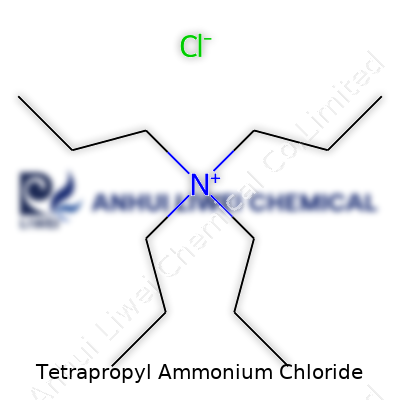
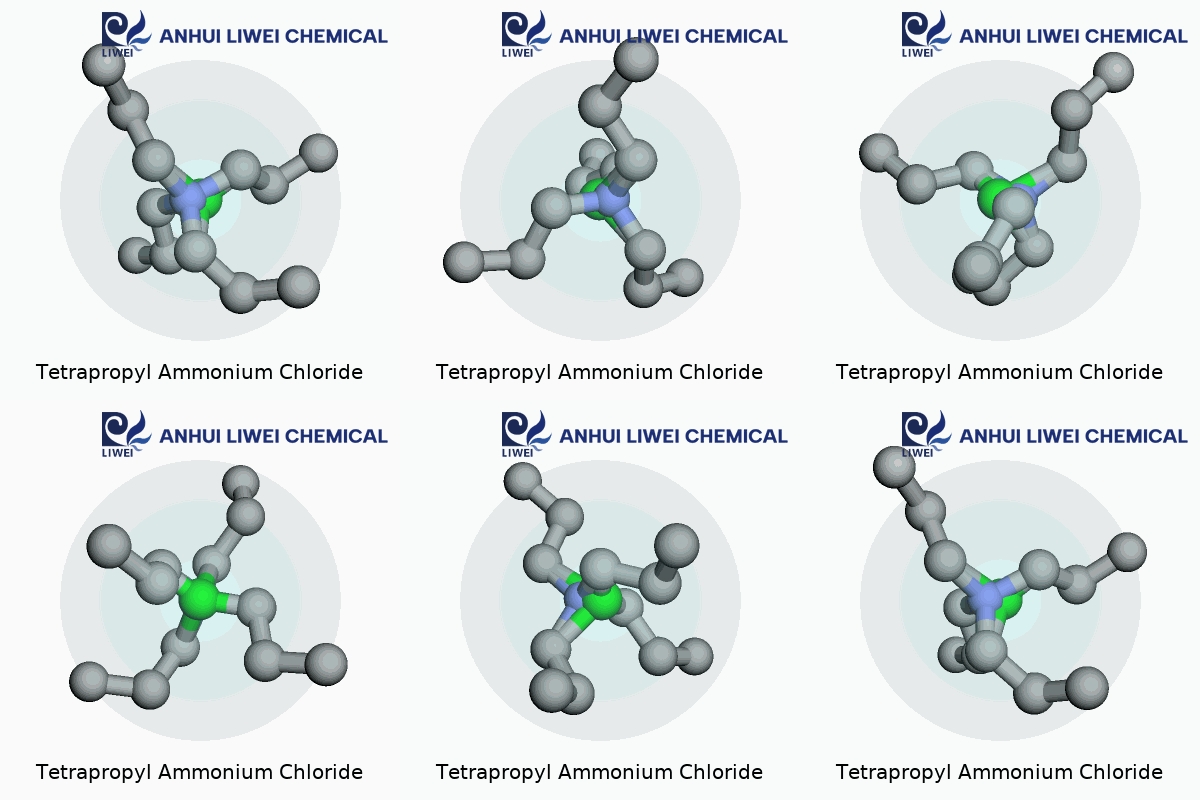
Tetrapropyl ammonium chloride forms as a solid at room temperature, with a melting point resting around 242-247°C. In the lab, hygroscopicity can pose challenges; it tends to absorb moisture if left exposed to air, which can complicate weighing and storage over the long haul. This compound dissolves readily in water, ethanol, and dimethyl sulfoxide (DMSO), but it stays relatively stubborn in nonpolar solvents like hexane. Chemically, it remains stable under standard conditions, resisting oxidation or reduction in ambient environments. The molecular structure, a symmetric quartet of propyl groups anchored to a central nitrogen, influences solubility and reactivity, offering a balance between lipophilic tendencies and ionic behavior.
Technical Specifications & Labeling
Manufacturers typically package tetrapropyl ammonium chloride in high-density polyethylene containers, with each drum carrying detailed information: batch number, production or expiry dates, purity (commonly 98% or higher for technical and analytical grades), storage guidance, and key hazard warnings. The labeling features signal words indicating possible hazards, correct pictograms according to the Globally Harmonized System (GHS), and emergency contact numbers. Good suppliers back their shipments with certificates of analysis, listing common impurities such as dipropylamine, chloride residue, and moisture content. Lab staff, especially new hires, appreciate clear labeling so as to avoid mix-ups with similar-looking quaternary ammonium salts, which may carry higher toxicity or different reactivity profiles.
Preparation Method
The most common route to tetrapropyl ammonium chloride comes from the classic Menshutkin reaction, where tripropylamine reacts directly with propyl chloride, usually in a polar solvent under reflux. Careful drying of reactants helps reduce unwanted side products resulting from hydrolysis or over-alkylation. Once the reaction completes, the mixture gets washed, filtered, and the final product recrystallizes from ethanol or acetone to increase purity. Each step demands attention: controlling the rate at which propyl chloride is added, monitoring temperatures to avoid decomposition, and scrupulously excluding moisture. Larger factories automate much of this, using jacketed reactors and in-line analytical probes to maintain consistency across batches.
Chemical Reactions & Modifications
Tetrapropyl ammonium chloride acts as a robust phase-transfer catalyst, shuttling otherwise insoluble ionic reactants across boundaries into organic reaction phases. Chemists rely on it during nucleophilic substitution, halide exchange, and oxidation processes. It supports the synthesis of a wide variety of organic compounds, from herbicides to pharmaceuticals. In electrochemistry, its presence in the electrolyte as a supporting salt can subtly influence reaction rates, impacting current efficiency. The propyl groups open some doors in modification; exchanging the chloride counterion for others, such as bromide or hydroxide, extends its use into fields like ion-exchange membranes and polymer stabilization. In all these reactions, the structure’s steric bulk, electron donation from the alkyl chains, and ionic nature keep the compound both chemically distinctive and practically useful.
Synonyms & Product Names
Tetrapropyl ammonium chloride goes by several alternate names, depending on old literature, local sources, or supplier branding. Common synonyms include N,N,N-Tripropylpropan-1-aminium chloride, TPAC, and simply tetrapropylammonium chloride. Each supplier assigns catalog numbers specific to their inventory system, which can confuse buyers skimming chemical listings. I’ve seen some labs refer to it generically as “quaternary ammonium chloride,” but best practice sticks with precise naming to avoid errors when ordering or cataloging supplies.
Safety & Operational Standards
Handling tetrapropyl ammonium chloride takes care and strong adherence to safety rules. Inhalation of dust or direct skin contact irritates, and high concentrations can trigger nausea or dizziness. Local exhaust ventilation, gloves, goggles, and dedicated chemical-resistant coats form the basic defense in every lab or plant using the powder. Storage away from acids, oxidizers, and moisture preserves stability and guards against accidental reactions; manufacturers advise keeping it in sealed, labeled containers under mild, dry conditions. Emergency data sheets, training for new technicians, and clear signage all help reduce on-site risks. Spills get swept up and disposed of as hazardous waste after dampening to minimize airborne dust, and any incident triggers a record for compliance teams. Health authorities such as OSHA in the US and ECHA in the EU issue guidance based on evidence from occupational exposure studies, updating protocols when new data emerges.
Application Area
Chemists across academic, industrial, and quality control labs depend on tetrapropyl ammonium chloride for its phase-transfer capabilities. In organic synthesis, it speeds up reactions between water-soluble and oil-soluble compounds—one routine example being the alkylation of phenols to produce flame retardants and plasticizers. Polymer scientists mix it into ionic liquids or cast membranes for solid-state batteries, capitalizing on the salt’s conductivity and stability at elevated temperatures. Analytical chemists use it as a buffer additive in high-performance liquid chromatography (HPLC) and capillary electrophoresis, improving separation and peak sharpness. On the research side, teams explore its utility in catalyzing new transformations or stabilizing reactive intermediates, especially in green chemistry where reducing reliance on toxic heavy metals sets the agenda.
Research & Development
Tetrapropyl ammonium chloride attracts sustained research interest because its structure provides a reliable testbed in catalysis and electrochemistry. Teams in leading universities and start-ups tinker with ways to recycle it from reaction mixtures, recover it after phase-transfer catalysis, and substitute in green solvents instead of the traditional toxic organics. Developing new synthetic methodologies leans on this compound for proof-of-concept reactions, particularly when measuring yields, rates, and selectivities across diverse reaction classes. Data from these studies feed into computer models predicting catalyst efficiency on an industrial scale. There’s continued investigation into how structural tweaks—switching out propyl groups for other alkyl chains or pairing the cation with different anions—alter performance in real-world processes.
Toxicity Research
Toxicologists keep close tabs on quaternary ammonium compounds like tetrapropyl ammonium chloride, running chronic and acute toxicity assays on rodents and aquatic life. Existing research shows that, compared to shorter-chain analogs, its toxicity edges higher due to greater membrane permeability, so wastewater and disposal protocols take on added importance. Research from the early 2000s revealed potential bioaccumulation if released unchecked into waterways, raising or lowering permissible discharge limits. Lab animals exposed via inhalation or ingestion developed symptoms of neurological and hepatic stress at sustained high doses. These studies push industry toward pre-treatment and chemical containment strategies instead of letting spent material run off into municipal waste. Safety teams stress regular health monitoring for staff exposed during prolonged synthesis runs or large-scale packaging operations.
Future Prospects
As the chemical sector steers toward sustainability and efficiency, tetrapropyl ammonium chloride stands ready for more adaptation. Technological advances in membrane and battery research lean on the compound’s conductivity and low volatility, with hopes pinned on pairing it with new biocompatible solvents and biodegradable components. The pharmaceutical industry eyes safer, cleaner reaction pathways, and quaternary ammonium salts like this one keep earning their place for reliability and reduced byproduct formation. There’s talk in industry circles about engineered derivatives, adjusting the alkyl chain lengths or swapping chloride for lower-hazard counterions. As regulation tightens and calls for greener chemistry grow louder, manufacturers and researchers will need innovation—both in how the compound gets made and how waste streams get treated—if tetrapropyl ammonium chloride is to maintain its reputation as a go-to solution across so many fields.
Getting to Know Tetrapropyl Ammonium Chloride
Tetrapropyl ammonium chloride stands out from most of the chemicals people run into at home or at the store. Its name doesn't exactly roll off the tongue, but in chemical labs and a handful of industries, it fills a unique niche. Speaking from years working around chemical plants, a compound with “tetrapropyl” in its name usually signals it’s headed for a process that calls for precision and reliability, not your run-of-the-mill household task.
Why Manufacturers Turn to Tetrapropyl Ammonium Chloride
Manufacturers value tetrapropyl ammonium chloride for its ability to act like a phase transfer catalyst. What this means on the floor is that it helps shove molecules from one liquid phase into another, letting reactions kick off that might otherwise just stall out. For example, in the world of synthetic chemistry, bringing together oil- and water-based ingredients is a huge headache. Adding a phase transfer catalyst gets those usually stubborn chemicals to interact, speeding up the process and reducing energy demands.
An instance of this I remember involves a production plant making specialty polymers. Without a phase transfer catalyst, yields dropped, waste shot up, and the cost for each batch climbed. After the team switched to using tetrapropyl ammonium chloride, the process ran cleaner and the quality improved. The catalyst didn't just save a few bucks—it made high-quality materials possible that enable things like long-lasting pipes and sturdy electronic parts.
Other Places Tetrapropyl Ammonium Chloride Makes a Difference
You’ll spot this compound in a few other corners of manufacturing, too. In the world of electrochemistry, tetrapropyl ammonium chloride can serve as an electrolyte. So in a lab, it might help migrate ions during battery or capacitor research. That has real-life consequences—low-resistance electrolytes can open the door to better-performing energy storage, and those improvements trickle down to things we use every day, like phones and power tools.
Another important use comes from its role in producing advanced zeolites, which are molecular sieves often used to filter or catalyze reactions. Without an efficient template agent like tetrapropyl ammonium chloride, making high-quality zeolites becomes much trickier. Those zeolites end up improving fuel quality at the refinery and even help cut harmful emissions from car exhausts.
Taking a Look at Safety and Environmental Questions
The industry benefits stand out, but talking about chemicals without mentioning safety wouldn’t be right. From hands-on experience, stricter rules and extra safety controls are always needed with compounds like this. Inhalation or heavy skin contact isn’t a good idea. Proper storage and disposal mean keeping workers safe and making sure the environment around these plants avoids risks. While the substance itself isn’t especially dangerous at the quantities often seen, accidents or improper disposal can cause issues.
How the Industry Can Do Better
Promoting safer handling and more effective cleanup procedures stands out as a clear solution. Research into bio-based or less hazardous alternatives remains ongoing, but so far, nothing matches the efficiency and impact of tetrapropyl ammonium chloride in certain industries. Developing processes that use the smallest volumes possible, recycling catalysts where practical, and keeping the workforce trained all bring risks down and keep production moving smoothly.
Tetrapropyl ammonium chloride may not show up in a news headline, but its impact can ripple out from chemical labs straight through to products that touch everyday life. Appreciating these links means weighing value and responsibility, especially when the stakes run so high.
Assessing Tetrapropyl Ammonium Chloride in Everyday Context
Tetrapropyl ammonium chloride doesn’t show up in ordinary conversations. Even so, for those who work in chemical labs, water treatment, or specialty manufacturing, this compound comes up often enough to spark questions about risk. The truth is, chemicals like this cause genuine worry for people on the shop floor and families living nearby factories. Years spent in environmental work and time shared with chemical safety professionals have taught me people crave straight talk about health risks, not just technical jargon.
The Health Profile
Most public databases—including the US National Library of Medicine and the European Chemicals Agency—point out that tetrapropyl ammonium chloride, when handled in concentrated forms, can irritate skin, eyes, and lungs. Breathing mists or vapors, or getting splashed, brings clear discomfort. Folks who work with it daily use gloves, goggles, and ventilation, not out of habit, but from first-hand experience with chemical burns and accidental splashes.
No one has yet proven the compound to be a cause of cancer, birth defects or mutations in humans. That said, few thorough long-term studies exist. The lack of clear evidence isn’t a free pass. Often, companies lean on the absence of proof as an excuse to relax safeguards, but doing so can put workers at unnecessary risk.
The Question of Toxicity
So far, acute toxicity studies in laboratory animals haven’t shown high death rates at low doses, but strong concentrations have led to symptoms like nausea and vomiting. In labs, scientists notice cell damage and membrane disruption at specific levels. Experience tells me that chemical risks run on a spectrum, not a simple safe-or-dangerous divide. I’ve seen people develop long-term skin sensitivities from repeated minor exposures to similar ammonium compounds.
Environmental agencies keep an eye on how tetrapropyl ammonium chloride breaks down in water. Once it spills or leaks into waterways, it can harm aquatic creatures. Fish, for instance, absorb this compound quickly, and a high enough dose proves toxic. With water safety already on shaky ground in many places, even small leaks deserve attention.
Reducing Risk in Homes and Workplaces
What counts most is diligent training and consistent enforcement of workplace safety standards. Standard process—use gloves, goggles, aprons, fume hoods, and label every container. In places with looser oversight, I’ve watched casual shortcuts end with emergency room visits and months of investigation. Safety data sheets, typically dismissed as “just paperwork,” hold life-saving information for emergencies.
Proper disposal makes a difference. Pouring unused chemicals down the drain or tossing stained rags in regular trash pins the risk on sanitation crews and local water tables. Hazardous waste programs cost money, yes, but the cleanup from widespread contamination drains local budgets and puts families at risk for years to come.
What's Next?
Open communication between chemical suppliers, employers, and community members should become standard practice. Workers need more than just one-time safety training sessions. Regular refreshers and honest reporting of near misses or minor accidents help fix hazards before something serious goes wrong. For families living next to factories, transparent air and water testing—shared without red tape—builds trust that’s too often missing in towns shadowed by industry.
Tetrapropyl ammonium chloride won’t ever be as familiar as household bleach, but that doesn’t mean people should accept mystery or silence about it. Good information guides safe choices. That, more than any warning sign or label, keeps us all safe.
Understanding the Chemistry
Ask any chemist about Tetrapropyl Ammonium Chloride and you’ll probably get a well-rehearsed answer: its chemical formula is C12H28NCl. That formula may look like a row of scratchy characters to anyone who doesn't work in a lab. Yet those numbers and letters mean a lot. Four propyl groups—each one a chain of three carbons with hydrogen hugging the sides—all circle up around a single nitrogen atom. Then, a chloride ion latches on, balancing things out to make a salt. It’s not just a neat trick with atoms; this crystalline compound pops up in real industry, not just in the back pages of a textbook.
Where Science Meets Everyday Utility
In the real world, you don’t find Tetrapropyl Ammonium Chloride at the grocery checkout. It works behind the scenes. In my old research group, we used it in the synthesis of zeolites—a lot of people call them the “molecular sieves” of chemistry. These structures help separate gases, purify water, or speed up reactions in industry. Tetrapropyl Ammonium Chloride doesn’t just sit in the pot; it guides the shape of these molecular sieves, like a template for a building frame.
From an experience point of view, accuracy with chemicals always matters. I remember one rookie error mixing up similar-sounding quaternary ammonium salts. It led to the wrong shape zeolite; a week down the drain. Calling out the right formula—C12H28NCl—prevents mix-ups that waste time and money. Major chemical suppliers list this substance for its importance in creating specific catalytic materials or functionalized polymers.
Safety and Environmental Concerns
Safety never stops with these compounds. There’s a temptation to treat chemicals used behind the scenes as mundane, but Tetrapropyl Ammonium Chloride has properties that ask for caution. It dissolves easily in water, remains stable below its melting point, and can cause moderate irritation when handled carelessly. Like any quaternary ammonium compound, there’s also the ecological footprint to keep in mind. Wastewater labs have noted that improper disposal leads to aquatic toxicity. Good lab habits—like labeling solutions properly and neutralizing waste—help protect both researchers and ecosystems. Having seen how even minor spills travel through drains, I always pay extra attention during clean-up.
Looking for Solutions and Better Practices
The field pushes for substitutes and more sustainable methods all the time. Some groups are hunting for greener surfactants or different templates that break down more easily after they’ve served their purpose. Finding ways to recover and reuse the template, or switch to recyclable alternatives, also picks up momentum in green chemistry circles. Grants often flow more readily to labs willing to document these efforts, so the drive for improvement isn’t just ethical—it’s practical.
Experience taught me nothing replaces vigilance. Even common-sounding chemicals deserve respect and a double-check on their formulas and safety sheets. Tetrapropyl Ammonium Chloride’s formula, C12H28NCl, packs a punch far beyond its straightforward structure. For researchers, quality matters; for users, so does handling; and for the planet, responsible disposal counts. The conversation around this compound keeps growing, and that benefits everyone—inside and outside the lab.
What Tetrapropyl Ammonium Chloride Wants from Its Home
Tetrapropyl ammonium chloride sounds like a mouthful, but out in the real world, it counts as just another routine chemical for labs and factories. Despite its routine, this stuff deserves some respect. I've seen what happens when chemicals linger in forgotten storage, and trust me, shortcuts can cost folks time, money, and sometimes a lot more.
No Room for Careless Storage
If you stash tetrapropyl ammonium chloride on any old shelf, don’t be surprised when moisture decides to join the party. This salt has a strong pull toward water, and clumping can lead to issues during later use. More than once, someone thought they could scoop out dry powder and found a goopy mess instead. Protect it from humidity and it’ll reward you with easy handling every time.
Temperature Is Not Just a Number
Leaving chemicals where direct sun or high heat blasts through isn’t just poor planning, it ramps up safety risks. Tetrapropyl ammonium chloride stores best away from heat sources and sunlight. Inside a simple plastic drum or tightly sealed jar, in a cool room, not much goes wrong. Keeping it below 30°C works for most cases—higher temps mess with purity and shelf life.
Forget the Near-Misses: Labeling Matters
A label can seem like a tiny thing—just a sticker, really. But a missing label has started more emergencies in labs than spilled liquids. Every container, no matter how small, shows exactly what’s inside, who bought it, and when. Those three details turn a random jar back into a valuable item, not a mystery to guess at during an audit.
Chemical Neighbors Often Don’t Get Along
Storing tetrapropyl ammonium chloride with careless neighbors invites problems. Acids nearby multiply risks. I remember a facility manager who crammed halides and acids together to “save shelf space.” One leaky bottle later, and the clean-up crew had a long night. Give chemicals their space—keep things separated to cut down on surprise reactions or ruined stocks.
Simple Security Always Pays Off
Security gets little attention until the day someone wanders into storage without knowing the rules. Lock up the chemical storage area and only let trained hands handle the keys. Not only does it help with inventory tracking, it also limits risk if something ever goes wrong. Having logbooks helps settle arguments, too, when someone wants to know who used the last kilo of stock.
Personal Responsibility and Company Policy
Every big chemical incident I’ve read about starts with the small stuff. Maybe it’s a broken cap, maybe a forgotten re-order or a missing spill kit close to the stack. Regular checks and practical policies lower those odds. Staff meetings work well for reminders—share what happened elsewhere and people get the point.
Solid Solutions—Stick With the Basics
Tetrapropyl ammonium chloride likes a dry, cool, shaded spot, far from acids and direct sunlight. Label everything, review stocks, and train people who work with it. Simple steps turn storage into a sure thing. New tools come along, but human attention and routine still tell the whole safety story.
Getting Down to Brass Tacks with Chemical Solubility
Tetrapropyl ammonium chloride crops up in some discussions about specialty chemicals, but folks tend to glaze over just what happens when this compound meets water. Let’s cut through the haze and talk about real experience, practical chemistry, and why any of this matters. My own background in lab work makes me treat every chemical with healthy skepticism. Nothing’s worse than prepping a solution and ending up with a cloudy mess.
What Happens in the Beaker?
If you dump a spoonful of tetrapropyl ammonium chloride into water, you’ll see it dissolve with ease. No special tricks or exotic solvents—plain old H2O gets the job done. This salt, built from a tetraalkylammonium cation and a chloride anion, slides right into water thanks to its ionic nature. In the lab, sometimes you almost take for granted that salts dissolve, but not every quaternary ammonium salt behaves so predictably. Tetrapropyl ammonium chloride acts a lot like its cousin, tetramethyl ammonium chloride, when dropped in water: both vanish into clear solution with a little stirring.
Why the Solubility Question Matters
Anyone who’s mixed chemicals for a living knows that solubility isn’t some fussy, academic point. Suppose you’re working on phase-transfer catalysis, prepping ionic liquids, or running a simple separation. If your compound forms sludge or doesn’t fully dissolve, that means wasted time, bad yields, and sometimes real risk (nobody wants to explain a failed synthesis at the Monday meeting). On the other hand, a salt that dissolves quickly makes dosing and mixing easy, even at scale.
What Do the Facts Say?
I’ve seen chemical catalogs list high solubility for this stuff—up to 500 grams per liter at room temperature. It’s more than clear solution; it’s bordering on syrup if you push the concentration. Published literature backs this up. The Journal of Physical Chemistry and material safety data from established suppliers both list tetrapropyl ammonium chloride as highly water-soluble. There’s no guesswork. It doesn’t matter if you’re in an academic lab or producing industrial batches—this salt won’t leave crystals in your flask.
Potential Hiccups and Smart Moves
Just because something dissolves doesn’t mean you’re out of the woods. High concentrations can raise concerns about handling and storage. Hygroscopic salts, including this one, soak up moisture from the air. I’ve lost whole batches by leaving a jar open. If you need reproducible results, keep containers sealed and weigh out quickly. Water solubility also means it rinses away easily—handy for cleanup, but if you care about downstream waste streams, you can’t ignore environmental impact. Ammonium compounds aren’t benign; wastewater regulations apply.
Takeaway: Go In With Open Eyes
A compound like tetrapropyl ammonium chloride won’t fight you in water. This is good news for folks mixing up solutions, running syntheses, or troubleshooting sticky processes. Experience has taught me not to take these details for granted. Fast, full solubility saves hassle. But always read those safety sheets, check regulations, and practice good habits in the lab. Knowing how your reagents behave in water isn’t just trivia—it keeps projects on track and lets the chemistry shine.