Triphenyl(Tetradecyl)Phosphonium Bromide: Deep Dive and Practical Guide
Historical Development
The road leading to triphenyl(tetradecyl)phosphonium bromide started getting paved in the mid-20th century, long after chemists first separated and characterized the basic phosphonium salts. Scientists in organic and organometallic chemistry saw the potential of phosphonium ions for alkylation, extraction, and phase transfer catalysis. The lure of combining triphenylphosphine—already a favorite workhorse in labs for its strong electron-donating ability—with a long alkyl chain and a bromide anion, carried obvious promise for materials science and synthetic chemistry. Using abundant phenyl and alkyl reagents, researchers began to discover that the right mix could open new doors into ionic liquids, functional surfactants, and anti-microbial chemistry. Documented lab records from the 1970s through 1990s show increasing reference to long-chain phosphonium salts as both tools and objects of study, especially as analytical equipment and computational chemistry advanced. Industry picked up the signal: reliable protocols emerged, and soon triphenyl(tetradecyl)phosphonium bromide started showing up not just in academic articles, but in patents and technical bulletins.
Product Overview
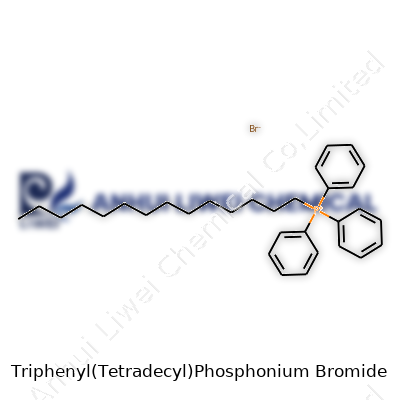
Triphenyl(tetradecyl)phosphonium bromide blends three phenyl groups and a single fourteen-carbon alkyl chain with a charged phosphorus atom at the center, partnered with a bromide counterion. In practical terms, this means you get a powdery or sometimes crystalline solid, usually off-white to pale yellow. It packs a strong ionic nature, not just on paper, but in the way it acts in reactions, as a phase-transfer catalyst, or as part of ionic liquid systems. Researchers and suppliers often refer to it by a few shorthand names or codes, but the core structure stays the same—four groups on phosphorus, one of them a long hydrocarbon tail, three of them phenyl rings, all together with a bromide. Chemists recognize the value: whether seeking a phase-transfer agent that tolerates organic and aqueous phases, or aiming for a surfactant that resists breaking down, this compound earns a place on many reagent shelves.
Physical & Chemical Properties
Digging into its physical and chemical traits, the biggest standout remains its amphiphilic structure—hydrophobic from the long alkyl chain, with the rest of the molecule feeling more polar and ionically charged. Melting point typically lands between 150–180 °C. It shows limited solubility in water, but dissolves quite well in a range of polar organic solvents—think acetonitrile, DMF, DMSO. The molecule holds together under moderate heating, but at higher temperatures or strong oxidation, the phosphorus-carbon bonds start to break. The bromide anion means the salt plays nicely in halide exchange reactions and helps dissolve into more polar solvents. Chemical stability impresses, but exposure to strong acids or bases for a long period likely chops up the molecule—those long alkyl chains don’t handle harsh chemical punishment very well. The molecular weight hovers around 564–580 g/mol, and the compound crystallizes well, so it’s not tough to purify with a little recrystallization or chromatography.
Technical Specifications & Labeling
Shipped and stored as a tightly sealed powder, triphenyl(tetradecyl)phosphonium bromide usually comes rated for 97% or better purity. Standard technical data lists melting point, solubility profiles, and a chemical structure diagram. Labels also carry the CAS number—177925-24-9. Suppliers tend to provide batch analysis, trace impurities, moisture content, and a spectral fingerprint using NMR or IR. These details aren’t just for regulatory compliance: chemists reference them to confirm expected reactivity in complex syntheses. Performance in sensitive reactions, such as ionic liquid formulations or as a phase-transfer catalyst, can hinge on these tiny purity and residual solvent variations.
Preparation Method
Most production routes for this salt rely on quaternization. Start with triphenylphosphine, add in 1-bromotetradecane under reflux, and you get triphenyl(tetradecyl)phosphonium bromide by nucleophilic substitution. Chemists run this in a dry organic solvent—toluene, acetonitrile, or sometimes THF. The reaction moves forward as the phosphorus attacks the alkyl bromide, swapping in the long alkyl group for one of phosphine’s lone pairs. After a couple of hours, you hit completion; cooling crashes out the solid, and a little filtration, solvent washing, and possibly recrystallization, makes a pure product suitable for further work. Scale-up doesn’t pose real hazards, aside from making sure the work stays dry and that excess unreacted 1-bromotetradecane gets cleaned away. Yields usually clock in above 85% with patience and clean glassware.
Chemical Reactions & Modifications
Triphenyl(tetradecyl)phosphonium bromide reacts like most quaternary phosphonium salts when exposed to strong nucleophiles—the phosphonium center rarely gives up its groups, but the bromide can take part in exchange reactions. That long alkyl chain survives normal handling, but oxidizers will break it down over time. In research labs, scientists swap out the bromide for other halides or apply the salt in Wittig-type olefination reactions, although bulkier analogues with methyl or benzyl chains remain more common for such organic transformations. The molecule’s significant bulk and amphiphilic structure push research into custom surfactants and highly specialized ionic liquids. It stays put in many reaction conditions where classic ammonium surfactants fail.
Synonyms & Product Names
A glance at catalogs and safety sheets uncovers a small tangle of names. The systematic label is triphenyl(tetradecyl)phosphonium bromide, but you’ll spot shorthand as TP14PBr, or triphenylphosphonium tetradecyl bromide. In older technical articles, the compound may sneak in as (tetradecyl)triphenylphosphonium bromide or N-tetradecyltriphenylphosphonium bromide, even if that last one runs against modern IUPAC rules. Companies sometimes market it as a phase-transfer catalyst by referencing the four-carbon fragment—C14—plus the triphenyl motif, so double-check CAS numbers when cross-referencing.
Safety & Operational Standards
Nobody should handle this salt bare-handed or in an open workspace. While not a heavy toxin, triphenyl(tetradecyl)phosphonium bromide causes skin and eye irritation, particularly as a fine powder. Lab workers keep gloves and goggles on, rely on fume hoods, and avoid inhaling dust. Storage stays simple: dry, out of sunlight, in a cool area with a tightly closed lid. In spill emergencies, sweep up gently, avoid stirring dust, and clean with damp cloths. Disposal uses chemical waste bins, not down the drain. Safety Data Sheets record it under irritant and environmental hazard categories, so anyone working around it takes sensible precautions—minimize direct skin or environmental contact, and always label containers sharply.
Application Area
Sometimes the best technology depends on molecules that don’t make headlines. Triphenyl(tetradecyl)phosphonium bromide walks into phase-transfer catalysis, where the balance between organic and aqueous solubility lets it bridge the divide in two-phase reactions, pulling ionic and organic materials together for faster, cleaner conversions. Material scientists look to its amphiphilic combination for building ionic liquids that work at room temperature, stable enough for electrochemical devices, lubricants, and long-lasting antistatic agents. In biology and medicinal chemistry, it has sparked interest as an antimicrobial agent—long alkyl chains often pore electrons into bacterial membranes, and the triphenylphosphonium core has a knack for navigating cell barriers. Research also explores it in sensors, advanced coatings, and even certain nanostructure assembly lines, thanks again to persistent ionic interactions in solution and at interfaces.
Research & Development
The curiosity around triphenyl(tetradecyl)phosphonium bromide expands every year. Academic teams experiment with tailored ionic liquids built on this and similar scaffolds—searching for stable, tunable solvents that can withstand electrical, thermal, and even radiation stress. Analytical chemists push for rapid separations involving big organic ions, test its performance head-to-head with established quaternary ammonium compounds, and monitor its behavior in chromatography. Electrochemistry labs value both its conductivity and stablity when building better electrolytes for batteries or fuel cells. Recent patents flag advanced surfactants containing this phosphonium, especially where lower volatility and environmental breakdown linger as priorities. Beyond all that, pharmaceutical researchers dip it into mitochondrial localization thanks to the triphenylphosphonium’s dive through membranes, hoping a tiny tweak turns the whole molecule into a drug-delivery vector or antimicrobial tool.
Toxicity Research
Trips to the toxicology literature paint a nuanced picture. Triphenyl(tetradecyl)phosphonium bromide doesn’t pose acute threats on the level of heavy metals or azide salts, but researchers keep an eye on cumulative exposure, especially for aquatic organisms and high-dose treatments in cell culture. Long alkyl chains—hallmarks of persistent, membrane-active molecules—present risk in many simple eukaryotes and tend to accumulate in lipid-rich tissues. Triphenylphosphonium itself crosses membranes with ease, so toxicity screens dig deep into mitochondrial function and potential for oxidative stress. Repeated testing reports LD50 values in the hundreds of milligrams per kilogram for rodents (oral), with significant irritation at lower local doses. Nobody considers this a “green” chemical: disposal always means special treatment in chemical waste. Workplace controls avoid airborne dust, skin contact, or environmental release, matching those for quaternary ammonium surfactants or cationic antimicrobial agents. The main safety tip comes down to: short exposure, small scales, good airflow, and don’t let it out into the ground or water.
Future Prospects
There’s real momentum behind further exploring what triphenyl(tetradecyl)phosphonium bromide brings to the table. Startups and academic teams eye it as a platform molecule, with tweaks to the alkyl length or aromatic groups unlocking whole new classes of functional surfactants, room-temperature ionic liquids, and stable electrolytic media. The search for safer, more efficient materials in batteries, green solvents, or nanoassembly keeps drawing research funding. As artificial membranes, sensors, and advanced electronics roll out, the dual nature of this phosphonium—both hydrophobic and ionic—offers chemical designers an extra “knob” to tune. Regulatory headwinds will continue tracking environmental persistence, but incremental modification and smart application may keep it in play as a bridge molecule, whether building greener catalysis, next-wave coatings, or surprisingly robust antimicrobial strategies. The compound’s adaptability speaks to a broader reality: progress sometimes comes from modifying the old molecules in fresh ways, not waiting for an entirely new class to drop from the sky.
Looking Beyond the Name
Triphenyl(tetradecyl)phosphonium bromide rolls off the tongue like a chemistry tongue-twister, but in labs, this odd molecule solves everyday problems. Slip it into a conversation with anyone in a synthetic chemistry department and you’ll spot the raised eyebrows—someone knows what it does, and probably knows a tough hurdle it helped them jump.
Helping Reactions Actually Work
The daily work of a chemist often breaks down into frustration over two liquids that just refuse to mix. Water and oil, classic enemies, won’t share a dancefloor. Reactions involving both sides of that divide often stall, wasting time and money. Triphenyl(tetradecyl)phosphonium bromide pops up here as what scientists call a “phase-transfer catalyst.” It bridges the water-oil divide. Suddenly, the reactants can meet and do what chemistry hopes they’d do all along. Common sense says “right tool for the job,” and this salt plays that role more often than most molecules with a name less complicated than its uses.
Why Chemists Care
I’ve talked to colleagues who swear by phase-transfer catalysts for “greener” chemistry. Less organic solvent ends up dumped down the line. Fewer harsh chemicals float around. It means smaller risks—and friends in environmental safety boards. The phosphonium part of this salt stabilizes its structure even in harsh conditions. It won’t break down too quickly, so the reaction runs smoothly. Many engineers in pharma and materials science see this as a shortcut to higher yields, cleaner products, and less headache.
Unique Benefits and Drawbacks
The longer alkyl tail—tetradecyl, in this case—lets this compound dissolve in oily environments while its charged phosphonium head interacts with water. Compared to other salts like quaternary ammonium compounds, these phosphoniums stand up under heat and strong acids. That adds value in multiple-step syntheses where conditions shift. A friend working in battery research once told me that every percent of higher efficiency matters. This salt helped him coax lithium salts into an organic phase. The cycle life on his prototype cell jumped, and the company took notice.
Safety Matters, Always
Scientists treat all phosphonium salts with caution. Skin contact, eye splashes, inhalation — all no-nos without proper protection. Waste handling can’t be slipshod; improper disposal can harm water systems. There’s growing attention on persistent compounds in waste streams, so companies investing into process chemistry with Triphenyl(tetradecyl)phosphonium bromide must plan cleanup at the design stage. Training and monitoring stick out here. Simple checklists and closed systems keep people and the planet safer. Waste minimization isn’t just a regulatory box to tick — it gives companies a reputation edge and moral peace of mind.
Smart Policies for Moving Forward
Watching chemical manufacturing evolve, the main push heads toward safer, simpler, and more efficient tools. Triphenyl(tetradecyl)phosphonium bromide checks boxes for many big projects, but regulations are catching up to specialty chemicals. Companies can invest in closed-loop processes and explore reclaiming these salts for reuse. Academic labs can train future chemists in green chemistry techniques, sparking ideas that cut costs and environmental burdens down the road. Partnerships between industries and regulatory agencies open doorways for safer, smarter chemistry.
Understanding What’s on the Label
Triphenyl(tetradecyl)phosphonium bromide looks like a mouthful on paper, and it raises questions for anyone concerned about chemicals in labs or industry. This compound, a quaternary phosphonium salt, pops up in applications all the way from chemical synthesis to potential biomedical uses. Chemical safety doesn't always sit at the top of people's minds until someone gets a rash or a spill happens—then suddenly everyone cares. Experience reminds me, before fiddling with any chemical, I track down its Material Safety Data Sheet (MSDS), not just the first page but the fine print buried in section after section.
What the Facts Say About Hazards
Let’s get right to it: triphenyl(tetradecyl)phosphonium bromide lands in a category of chemicals that deserve respect. Phosphonium salts generally irritate the eyes, skin, and respiratory system. This doesn’t sound scary until picking up a pipette and accidentally dribbling some on a bare hand. Companies supplying research-grade triphenylphosphonium compounds warn users about toxicity. These warnings aren’t just covering their backs—they point to real cases of skin corrosion and serious eye injury linked to related phosphonium salts.
Swallowing this chemical, breathing in its dust, or splashing it in an eye leads to much more than a bad day. The European Chemicals Agency database notes potential acute toxicity and severe irritation from this group of compounds. No one wants to be the lab tech who skipped gloves and landed in the ER with chemical burns.
Toxicity: Laboratory and Life
Animal studies on similar compounds show adverse effects on organs like the liver and kidneys when exposure runs too high. That traces back to the way such phosphonium salts interact with biological membranes. Some researchers use these chemicals for their very ability to disrupt cellular membranes—a property that turns helpful in scientific discovery but risky without solid precautions.
Reports in peer-reviewed literature confirm this: cell cultures treated with quaternary phosphonium salts often show decreased viability. So, although triphenyl(tetradecyl)phosphonium bromide hasn't sparked a health scandal, plenty of its close cousins are already flagged as hazardous.
To put it simply, this is not an ingredient anyone wants to breathe or rub on their skin, and definitely not something to taste. I remember a colleague who once underestimated a compound like this—he wore thin cotton gloves and thought he was careful. It took all of five minutes for his hands to start itching and blistering. Stories like these stick with you.
Keeping Workplaces and People Safe
In practical terms, safe handling means investing in decent gloves, working under a fume hood, and keeping a fresh set of safety goggles within reach. Regular soap won’t remove chemical contamination—so laboratory detergent and emergency eyewashes have to stay close.
Disposal matters just as much. Pouring leftover chemical down the drain does more than wreck pipes; environmental research links quaternary phosphonium salts to risks for aquatic organisms. It pays to follow local regulations for chemical waste collection, even if it means spending extra time on paperwork and waiting for hazardous waste pickups.
Training new people in the lab or plant keeps everyone safer, too. Spending half an hour on concrete safety examples trumps reading dry rule books. Personal exposure stories, safety data, and staying up to date with evolving chemical research bring home the seriousness without turning it into doom and gloom.
Responsibility Builds Trust
Staying alert to the risks of triphenyl(tetradecyl)phosphonium bromide and its relatives supports not just healthier workplaces but stronger trust between scientists, industry, and the public. Responsible handling, honest risk communication, and listening to evolving data help all of us avoid preventable harm without stopping progress where this chemical shows real value.
Taking Chemical Storage Beyond the Label
Triphenyl(tetradecyl)phosphonium bromide sits on the shelf in a tightly sealed jar. It looks like just another white powder, but it’s anything but ordinary. If you work in a lab or supply room, you know there’s a difference between obeying instructions and really understanding the reasons behind them. The label suggests a cool, dry spot and warns against light. Anyone who's spent enough time around specialty chemicals feels in their bones why storage isn't just a checklist, but a matter of safety and science.
The Reality of Dealing with Specialty Chemicals
Moisture creeps into every crack. I've left reagents out for what seemed like five harmless minutes and came back to clumped, sticky leftovers. Triphenyl(tetradecyl)phosphonium bromide doesn’t like water in the air. Leave a jar open on a humid day, and it soaks up more than you think. Over time, the performance in a reaction drops, and analysis sometimes reveals impurities. Closed tight with a well-fitting cap in a dry climate-controlled cabinet, this problem fades away. Dehumidifiers earn their spot in chemical storerooms for just this reason.
Light and Temperature: Subtle Saboteurs
Sunlight streaming in through a lab window doesn’t just brighten the room. UV and even strong visible light bring slow changes in some chemicals. Phosphonium compounds, with their organic cations, sometimes grow unstable under constant light. I once caught a faint yellow tinge in a sample after a few days on a benchtop in summer. Refrigeration isn't a requirement, but an unheated storeroom in winter or a shelf far from hot radiators and sunlight works best. Keeping things cool delays breakdown or reactions you didn’t ask for. Regular room temperature fits, so long as you avoid the extremes that a badly air-conditioned building or a sunny window can cause.
Lab Culture and the Real-World Risks
Chemists who spend years in shared spaces know how often jars go missing, lids get swapped, or something gets stashed “just for a day” in unsafe spots. At my first job fresh out of school, I lost reagents to leaky bags and untrustworthy shelving a bit too often. Locking the jar away, logging every entry, and training every new student on how to leave things as they found them—that’s how you win the battle against sloppy storage.
Labeling and Oversight: More Than Red Tape
A chemical like triphenyl(tetradecyl)phosphonium bromide won’t hurt you straight through the glass, but open the cap carelessly, and powders go airborne. Inhalation risks, accidental spills, skin contact—all real dangers you spot more clearly after one or two near-misses. Proper hazard labeling and accessible safety sheets belong right next to the shelf. You want to be able to see at a glance what you’re dealing with, not rely on memory or a half-peeled label. Regular checks—monthly or even biweekly—pick up on stuck lids and cracked jars before they become a crisis.
Building Better Habits in the Lab
Safe storage of triphenyl(tetradecyl)phosphonium bromide comes down to understanding the material, respecting its needs, and running a tight ship. Good storage protects purity and performance, and shows the human factor can make or break lab safety. It’s not about following a rule book, but building habits that keep both science and people safe under one roof.
Understanding the Chemical Structure and Formula
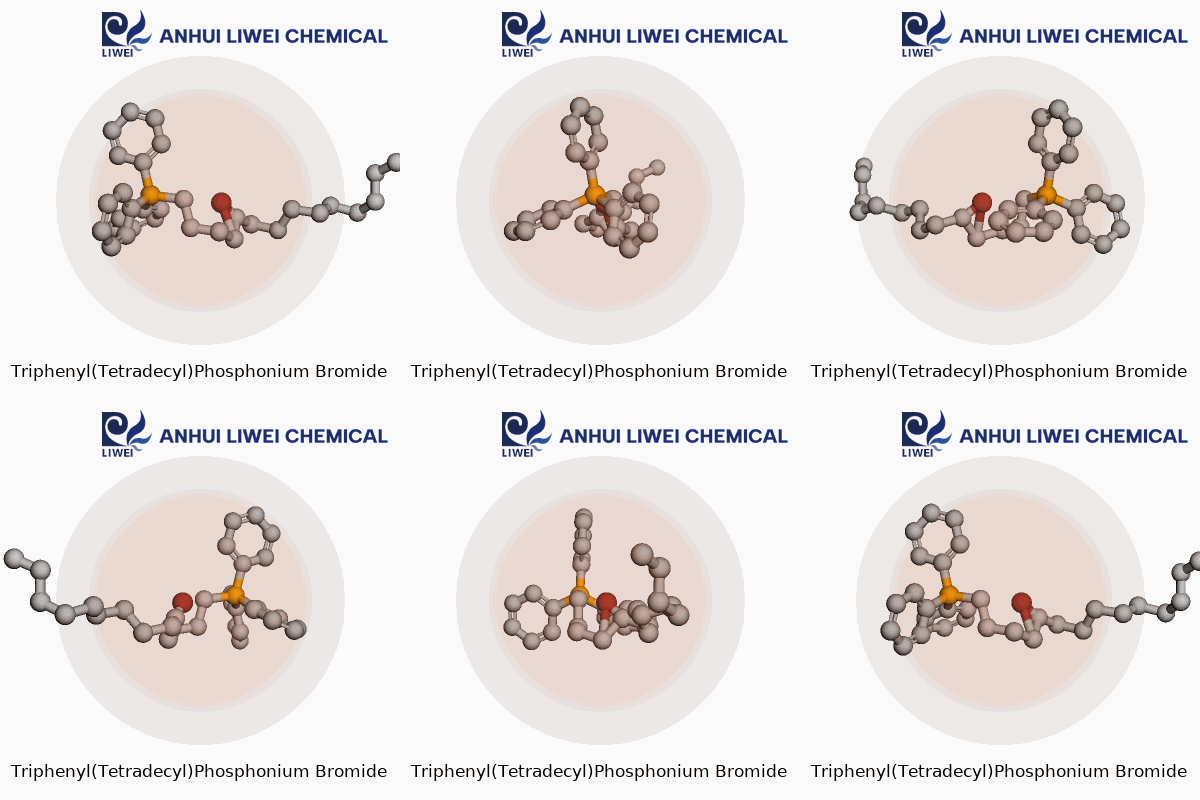
Triphenyl(tetradecyl)phosphonium bromide sounds like a mouthful. In labs, it’s often listed as C41H46BrP. The backbone of this compound includes a central phosphorus atom bound to three phenyl groups and one long tetradecyl chain. Bromide hangs by ionic attraction. So, put simply, this is not just a regular phosphonium salt you'd see in a basic textbook—the structure pulls in traits from both the aromatic phenyl rings and a lengthy alkyl tail.
Molecular Weight: The Numbers Matter
Chemists go by numbers, and here, the exact molecular weight makes a real difference. The sum for C41H46BrP lands at about 685.66 g/mol. That count factors in carbon, hydrogen, bromine, and phosphorus in their respective ratios from the formula. Anyone weighing out this substance for a synthesis or an experiment needs to respect this specific number, or experimental outcomes can swing wildly. If you’re preparing solution concentrations, eyeballing won’t cut it—precision here saves time and prevents waste in the lab.
Real-World Applications: Beyond the Fundamentals
This chemical stands out because of the unique properties that come with its design. Those phenyl rings—each made up of six carbons forming benzene—give stability and bulk. The long tetradecyl chain brings in significant hydrophobic character. When I first studied quaternary phosphonium salts, I saw how they out-performed ammonium salts for phase transfer catalysis in organic reactions. Triphenyl(tetradecyl)phosphonium bromide fits beautifully into situations where you want to shuttle ions from water into organic solvents.
In some advanced experiments, researchers use it as a surfactant or catalyst. Changing the length of that “tetradecyl” tail gives scientists control over solubility and interfacial tension, which plays a huge role in extractions or phase-transfer catalysis. You won’t ever see this compound in a household detergent aisle, but in synthesis labs, each tweak to the structure brings new possibilities.
Handling and Safety: Keeping an Eye Out
The bigger molecules get, the more one should pay attention to potential risks. Salts like this aren’t inherently toxic at low concentrations, but repeated exposure, inhalation, or accidental skin contact can cause issues. Chemicals that combine an organic component with a bromide ion deserve basic respect and proper PPE. Even as a researcher comfortable around more hazardous chemicals, I learned the hard way that a minor lapse with compounds like these creates cleanup headaches and health risks. Gloves and well-ventilated fume hoods go from being “nice to have” to a baseline expectation.
Room for Improvement and Alternatives
Triphenyl(tetradecyl)phosphonium bromide isn’t without its drawbacks. It can be pricey, and its shelf life depends on how it’s stored. Moisture and light can reduce effectiveness. Other quaternary phosphonium salts might offer lower cost or better thermal stability, depending on task. Finding the right compound isn’t just about looking at chemical formulas and weights; it’s about matching real properties with real needs. My experience has taught me that chasing the “perfect” reagent sometimes just means finding the one that gets the job done with the least compromise.
Bringing Facts Full Circle
Triphenyl(tetradecyl)phosphonium bromide—C41H46BrP, with a molecular weight of 685.66 g/mol—has carved a space in advanced laboratories for good reasons. Its unique mix of structure and function continues to make it a valuable tool, provided that those working with it bring both practical knowledge and respect to the bench.
Everyday Chemistry, Unusual Tools
Triphenyl(tetradecyl)phosphonium bromide sounds like something out of a textbook, but behind the mouthful of a name, there’s a story about what makes a good catalyst. In organic synthesis labs, getting two chemicals—one hydrophilic and one hydrophobic—to shake hands isn’t easy. That’s where phase transfer catalysts step in. Traditionally, quaternary ammonium salts own this territory, but phosphonium salts like triphenyl(tetradecyl)phosphonium bromide sometimes try to get a seat at the table.
What It Brings to the Reaction
This compound has both a bulky aromatic portion and a long alkyl chain. That makes it more than a simple salt; it acts as a bridge between water and organic solvents. Its structure reminds me that the line between workhorse chemicals and specialized reagents sometimes blurs. Phosphonium-based phase transfer catalysts have fans for good reasons:
- They’re often more stable under tough conditions, like high heat or strong base, than their ammonium cousins.
- They don’t break down as quickly, which helps in reactions demanding long stretches of time or higher temperatures.
These points stand out in reactions such as alkylations, oxidations, or the trusty Michael addition. From my experience in the lab, you don’t want your catalyst falling apart halfway through. That costs time and leaves behind junk in the final product.
Why It Rarely Gets the Spotlight
Well, if this phosphonium salt boasts advantages, why isn’t it on every chemist’s shelf? Cost and accessibility jump out first. Its synthesis isn’t as straightforward or as cheap as basic ammonium salts. Many labs, especially in teaching or on tight budgets, stick with what they know works and doesn’t break the bank.
Solubility also brings up headaches. The longer alkyl chain means it may work beautifully in some reactions but become greasy and sluggish in others, sometimes refusing to dissolve where you need it most. In practice, a catalyst that doesn’t play well with your solvents slows things down.
Solutions and Smart Choices
If we want chemicals like triphenyl(tetradecyl)phosphonium bromide to see more action, suppliers could look for routes that drop production costs. Researchers testing new reactions should take note of these salts’ heat stability. Screening them in places where ammonium salts break down might unlock healthy yields and cleaner products.
In my own trial runs, matching the right catalyst with the tough reaction often saves time and creates less waste. That means fewer failed reactions and more confidence for the next experiment. I’ve found that open communication with suppliers sometimes brings in rare reagents at lower costs—if enough demand pops up.
The Takeaway
Triphenyl(tetradecyl)phosphonium bromide may not be a household name, even in most chemistry labs, but its properties earn attention. For any new phase transfer challenge—especially those calling for heat or harsh reagents—this is a compound worth considering. The responsibility lies with chemists and educators to put it through its paces and share what happens. Sometimes, stepping beyond the usual tools brings fresh answers or at least some real stories to pass along.